

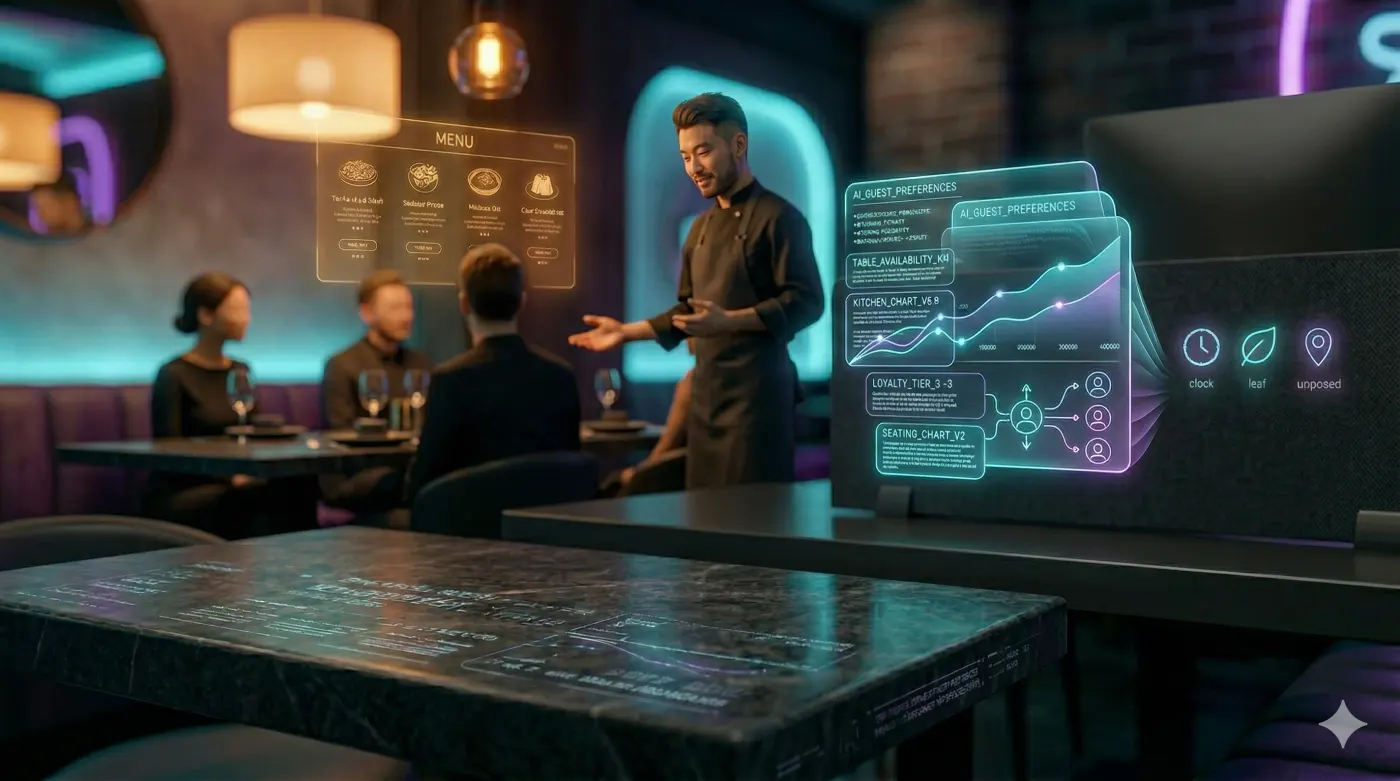
Your best server is not answering the phone right now. She is reciting today's specials to Table 7, remembering that the couple at Table 12 is celebrating an anniversary, and noticing that the family by the window needs high chairs. Meanwhile, the phone rings six times during the dinner rush. Four of those calls go to voicemail. Three of them were orders worth $45 each. That is $135 in lost revenue, not because your team is bad, but because they are human and they cannot be in two places at once.
This is not a story about replacing your server with a chatbot. It is the opposite. It is about getting the phone calls, the routine questions, and the repetitive order-taking off her plate so she can do what no AI will ever do: make a guest feel seen. The question has never been "will AI replace restaurant staff?" The question is: what should AI handle so your humans can be more human?
- 3%
of diners want fully automated restaurants (97% want humans)
- 65%+
of managers report higher satisfaction after AI adoption
- 41%
of restaurant employees would leave without adequate training
- 30-40%
of peak-hour phone calls go unanswered in most restaurants
The 80/20 Task Split: What AI Should Handle vs. What Humans Must Own
The practical framework is straightforward. Roughly 80% of customer interactions in a restaurant are routine and repeatable: phone orders, menu questions, hours inquiries, reservation confirmations, delivery status updates. These are the interactions where speed and consistency matter more than warmth. The other 20% are the moments that build loyalty: handling a complaint with empathy, celebrating a special occasion, making a personalized recommendation, or simply reading the room and knowing when a table wants conversation and when they want privacy. AI excels at the 80%. Humans are irreplaceable for the 20%. The mistake is assigning humans to both.
Give to AI (The 80%)
- Answering phone calls during rush hours
- Processing standard takeout and delivery orders
- Confirming reservations and sending reminders
- Answering menu questions (hours, allergens, prices)
- Handling reorders from repeat customers
- Sending promotional messages and seasonal offers
- Collecting post-meal feedback and review requests
- Managing waitlist notifications
Keep for Humans (The 20%)
- Greeting guests and reading emotional cues
- Handling complaints with empathy and authority
- Making personalized recommendations at the table
- Celebrating special occasions (birthdays, anniversaries)
- Managing VIP guests and unique requests
- Training and mentoring new team members
- Building relationships that drive repeat visits
- Making judgment calls the AI cannot anticipate
How Restaurant Roles Evolve With AI (Not Disappear)
When AI takes over phone ordering and routine inquiries, existing roles do not vanish. They evolve toward higher-value, higher-satisfaction work. The host who spent 40% of her shift answering phones now focuses entirely on guest experience. The manager who manually scheduled 20 employees now reviews AI-generated schedules (85% faster with McDonald's Virtual AI Manager) and spends that reclaimed time coaching staff and improving operations. The server who interrupted table service to take phone orders now gives undivided attention to every guest in the dining room.
How Each Restaurant Role Evolves With AI
Host / Hostess
Before AI: Phone Juggler
Splits attention between greeting walk-ins and answering ringing phones. 30-40% of calls missed during peak hours. Guests feel rushed at the door.
After AI: Guest Experience Lead
AI handles all phone reservations and waitlist management. Host focuses 100% on greeting, seating, and reading the room. First impression quality skyrockets.
Server
Before AI: Order Taker + Hospitality
Constantly interrupted by phone orders, routine questions, and manual order entry. Less time for table touches, upselling, and genuine connection.
After AI: Hospitality Specialist
AI takes phone and digital orders. Server focuses on tableside recommendations, occasion recognition, and building the personal relationships that drive 67% more spend from loyal customers.
Manager
Before AI: Administrative Firefighter
Hours spent on manual scheduling, inventory counting, call-back lists, and resolving order errors. Strategic work happens in the margins.
After AI: Operations Strategist
AI scheduling saves 85% of planning time (McDonald's data). Predictive demand forecasting reduces waste 23-51%. Manager coaches staff, analyzes trends, and improves the business.
Kitchen Staff
Before AI: Deciphering Messy Tickets
Handwritten or poorly entered orders cause confusion. Remake rates hit 8% during peak hours. Prep quantities guessed based on gut feeling.
After AI: Precision Execution
AI-entered orders are clear and accurate (95-98%). Predictive prep quantities reduce waste. Kitchen staff focuses on cooking quality, not decoding tickets.
The Staff Satisfaction Data: What Actually Happens After AI Adoption
The fear is that AI makes jobs worse. The data shows the opposite. Over 65% of restaurant managers report productivity and satisfaction boosts after adopting AI tools. Operations teams actually prefer working at locations with automation because it removes the repetitive grind. And the retention data is striking: restaurants with clear advancement paths retain 60-70% of employees long-term, while 41% of employees would leave a job that lacks adequate training opportunities. AI training is becoming part of that advancement path. The restaurants that frame AI as a skill upgrade for their team, not a threat, are winning the retention battle in an industry where 91% of operators cite labor as their top challenge.
65%+ Manager Satisfaction Increase
Managers report higher productivity and satisfaction after AI adoption. Less time firefighting means more time leading.
60-70% Long-Term Retention
Restaurants with clear advancement paths (including AI training) retain significantly more employees than industry average.
41% Would Leave Without Training
AI training is not optional for retention. Employees who feel left behind by technology leave. Investing in upskilling is a retention strategy.
85% Scheduling Time Reduction
McDonald's Virtual AI Manager cuts manual scheduling from hours to minutes. Managers reclaim time for coaching and strategic work.
The Wendy's Model: How "Crew Augmentation" Became the Winning Strategy
Wendy's FreshAI rollout across 160+ locations succeeded where McDonald's failed, and the difference was not the technology. It was the framing. Wendy's explicitly positioned AI as crew augmentation: the AI handles drive-thru voice ordering so crew members can focus on food preparation and customer service. When a complex order stumps the AI, it hands off to a human seamlessly. The result: 86% of orders handled without crew intervention, with accuracy jumping to 95% on the remaining cases where humans assist. Contrast this with McDonald's, which positioned AI as customer-facing replacement technology, triggered employee anxiety, and ended the program after three years.
Burger King took a third approach with its "Patty" AI assistant that lives inside employee headsets. Instead of replacing crew interactions with customers, Patty coaches staff in real time: monitoring friendliness, suggesting upsells, alerting managers about unavailable items. The AI makes the human better at their job. This is the model that works: AI as the invisible assistant that empowers the people who directly serve your customers.
The Implementation Playbook: Rolling Out AI Without Losing Your Team
Team-First Rollout
6 Steps to Deploy AI That Your Team Will Actually Embrace
The proven approach from Wendy's, Burger King, and Chick-fil-A
Map every task to AI or human
List every interaction your team handles daily. Sort them: routine/repeatable tasks go to AI. Judgment/empathy/creativity tasks stay with humans. Share this map with your team before launch.
Announce AI as a tool upgrade, not a headcount change
Be explicit: 'We are adding AI to handle phones and routine orders so you can focus on guests.' Address job security concerns directly and early. Ambiguity breeds anxiety.
Train your team ON the AI, not around it
Every staff member should understand what the AI does, when it escalates to them, and how to take over a conversation seamlessly. 41% of employees leave without training. Invest here.
Pilot with your most supportive team members
Choose 2-3 employees who are tech-curious for the first rollout. Their positive experience becomes the internal proof that converts skeptics. Peer influence beats management mandates.
Show the data: hours saved, stress reduced, tips up
Track and share metrics your team cares about: fewer phone interruptions, shorter peak-hour chaos, more time for table touches. When servers see their tips increase because they have more time with guests, adoption becomes self-reinforcing.
Create AI-related advancement opportunities
The employee who masters the AI dashboard becomes the 'AI Lead.' The server who trains others on chatbot handoffs gets a title upgrade. Build career paths that include AI skills. Retention follows investment.
The Economics: AI Does Not Cut Staff Costs. It Redirects Them.
The wrong way to think about AI economics is "how many employees can I fire?" The right way is "how much more revenue can my existing team generate when they are not answering phones?" A server who is free from phone duty can give better table service, which directly increases tips, upselling success, and customer satisfaction. Loyal customers spend up to 67% more than new ones, and the personal relationships that drive loyalty happen when your team has time for them. Meanwhile, the AI captures the 30-40% of calls that go unanswered during peak hours, recovering $3,000-$18,000 per month in orders that would have gone to competitors.
| Daily missed calls during peak hours | 15 calls |
|---|---|
| Average order value per call | $40 |
| AI capture rate of missed calls | 85% |
| Server upselling uplift with more table time | 15% |
| Average daily dine-in revenue | $3500 |
| Estimated monthly revenue gain from AI-human task redistribution | $31,050 |
$15,300 from recaptured calls (15 calls x $40 x 85% x 30 days) + $15,750 from upselling uplift (15% on $3,500 x 30 days). Your team is not costing less. They are earning more. | |
What Your Staff Is Actually Thinking (And How to Address It)
4 Staff Fears vs. What the Data Shows
What Staff Fears: I will be replaced by a chatbot
What Actually Happens: Only 3% of diners want full automation. 87% demand human connection. Your role shifts from phone-answering to hospitality, which is what you were hired for.
What Staff Fears: AI will monitor everything I do
What Actually Happens: Burger King's Patty AI coaches staff on friendliness and accuracy, not surveillance. The goal is making you better, not catching you being bad.
What Staff Fears: I will not be able to learn the technology
What Actually Happens: The best systems are designed for zero technical expertise. If you can use WhatsApp, you can manage a chatbot handoff. Training takes hours, not weeks.
What Staff Fears: My tips will decrease if customers order via AI
What Actually Happens: Servers freed from phone duty have more time for table touches and personalized service. Better service = higher tips. AI-driven upselling increases average check size 18-26%.
The best restaurant AI does not replace a single employee. It gives every employee a superpower they did not have before.
Empower Your Team. Capture Every Order.
AI That Makes Your Staff Better, Not Redundant
Ordering.co handles phone orders, routine questions, and after-hours messages so your team can focus on what builds loyalty: genuine hospitality. Human fallback built in. Staff training included. Designed for augmentation from day one.
Frequently Asked Questions
AI and Restaurant Staff FAQ
Practical questions about the AI-human task split in restaurants
Will AI chatbots actually replace restaurant staff?
No. Only 3% of diners want fully automated restaurants. 87% say human connection remains critical. The successful model is AI handling 80% of routine tasks (phone orders, FAQs, reservations) so humans focus on the 20% that builds loyalty: empathy, personalization, and genuine hospitality. Wendy's 160+ location success was built on this augmentation model.
How do restaurant employees feel about AI adoption?
Over 65% of managers report higher productivity and satisfaction after AI adoption. Operations teams prefer working at locations with automation because it removes repetitive tasks. However, 20% feel uneasy about AI scheduling, and 41% would leave without adequate training. The framing matters: Wendy's crew augmentation approach succeeded; McDonald's replacement approach failed.
Which restaurant tasks should AI handle?
AI should handle routine, repeatable interactions: phone orders during rush hours, menu and hours questions, reservation confirmations, delivery status updates, promotional messages, feedback collection, and waitlist notifications. Humans should own judgment-intensive tasks: complaint handling, personalized recommendations, special occasion recognition, VIP management, and relationship building.
How do I introduce AI without scaring my team?
Be explicit from day one: AI handles routine tasks so staff can focus on guests. Never deploy AI without telling your team first. Train every employee on the system. Pilot with tech-curious team members whose positive experience converts skeptics. Track and share metrics staff care about: fewer phone interruptions, more table time, higher tips. Build AI-related advancement paths.
Do servers make more or less money when restaurants use AI?
More. Servers freed from phone duty have more time for table touches and personalized service, which directly increases tips. AI upselling increases average check size by 18-26%, and higher checks mean higher percentage-based tips. Loyal customers who get better attention spend up to 67% more than new customers. The math favors the server.
How did Wendy's succeed with AI where McDonald's failed?
Wendy's positioned AI as crew augmentation: the AI handles routine drive-thru orders so crew focuses on food quality and service. When AI struggles, it hands off to a human seamlessly. 86% of orders are handled without intervention, 95% with human assist. McDonald's positioned AI as customer-facing replacement, triggered employee anxiety, had accuracy failures, and ended the program.
How does AI affect restaurant employee retention?
Restaurants with clear advancement paths (including AI training) retain 60-70% of employees long-term. 41% of employees would leave a job without adequate training. AI training creates new career paths: AI Lead, Chatbot Manager, Digital Operations Specialist. Retention improves when employees see AI as upskilling, not downsizing.
What is the revenue impact of freeing staff from routine tasks?
AI captures 30-40% of calls that go unanswered during peak hours, recovering $3,000-$18,000 per month in lost orders. Servers with more table time increase upselling success by 15%+ and build loyalty that drives 67% higher spend from repeat customers. The AI does not cut staff costs. It redirects staff effort toward revenue-generating activities.
Your Team Is Not the Problem. Their Task List Is.
Your best employees are not struggling because they lack skills. They are struggling because they are doing three jobs at once: answering phones, taking in-person orders, and trying to provide the hospitality that keeps customers coming back. AI does not solve a people problem. It solves a task allocation problem. Give the routine to the machine. Give the human moments to the humans. The 97% of diners who want human connection will thank you. Your staff will thank you. And the $3,000-$18,000 per month in recovered revenue will speak for itself.