

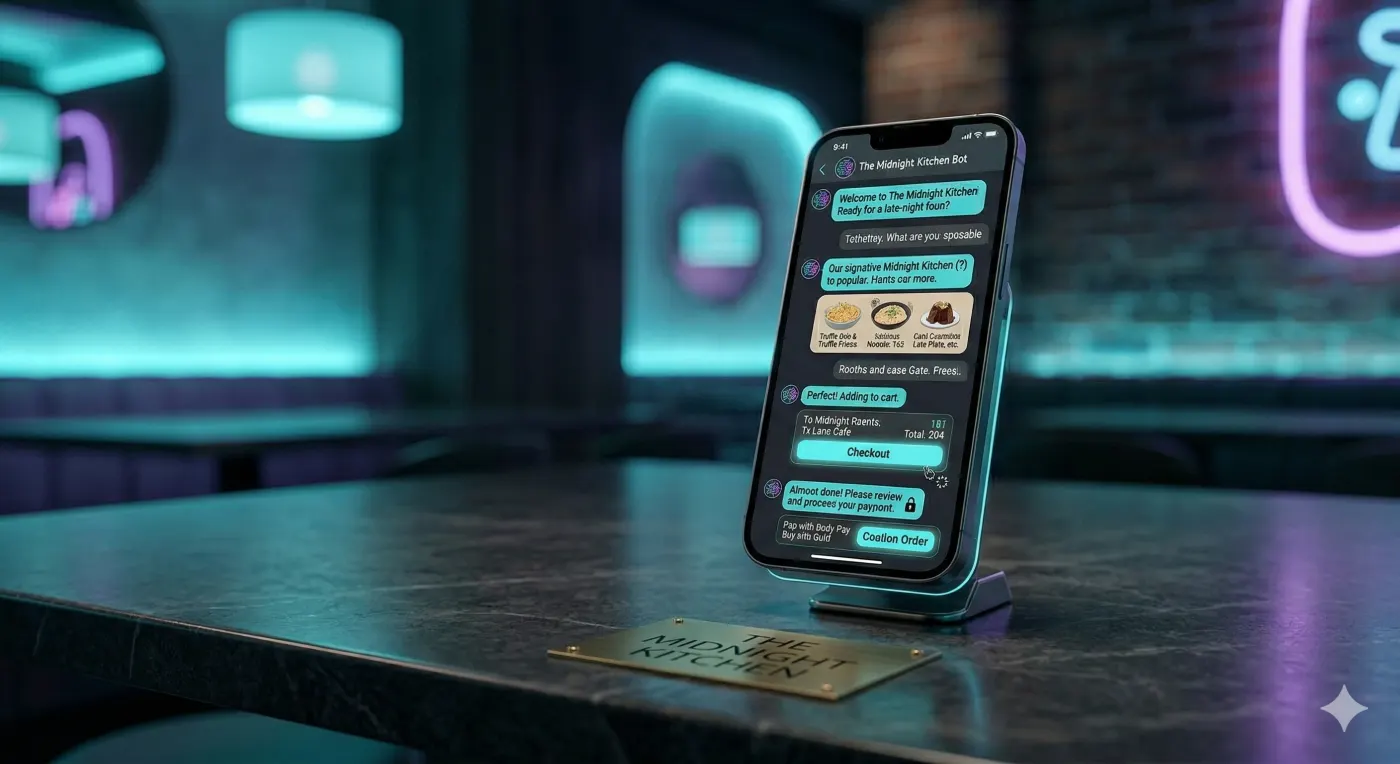
Your email campaigns reach 21% of your customers. Your chat messages reach 98%. The question is not whether to use chat for marketing. It is why you waited this long.
The Marketing Channel Hiding in Your Chat Window
Most restaurants think of their WhatsApp or web chat as an ordering tool. A customer sends a message, the AI takes the order, done. But that transactional mindset leaves the biggest marketing opportunity in hospitality completely untapped.
Conversational marketing is the practice of using real-time, one-to-one conversations to build relationships, learn customer preferences, and drive repeat business. Unlike email blasts or social media posts that shout into the void, chat creates a dialogue. And that dialogue is where loyalty begins.
- 98%
Chat message read rate
- 45%
Average chat response rate
- 21%
Email average open rate
- 5%
Social media organic reach
Those numbers tell a clear story. When you send an email newsletter about your weekend brunch special, roughly 4 out of 5 customers never see it. When you send a chat message to someone who ordered brunch last month, virtually all of them read it, and nearly half reply. That is not a marginal improvement. That is a fundamentally different channel.
The Conversational Marketing Loop
Effective conversational marketing is not about sending promotional messages. It is a continuous loop where every interaction makes the next one smarter and more relevant. Here is how it works for restaurants.
The Conversational Marketing Flywheel
Every conversation feeds the next one
Attract
Customer discovers your chat on WhatsApp, your website, or Instagram
Converse
AI engages naturally, answers questions, takes orders, builds rapport
Capture
Every conversation reveals preferences, dietary needs, visit patterns
Segment
AI groups customers by behavior: regulars, weekend diners, delivery fans
Personalize
Send relevant messages based on actual preferences, not assumptions
Re-engage
Bring customers back with perfectly timed, personalized touchpoints
Why Chat Outperforms Every Other Restaurant Marketing Channel
Restaurant marketing has traditionally relied on three pillars: email newsletters, social media posts, and paid ads. All three share the same fundamental problem: they broadcast to audiences that are not listening. Chat flips this model entirely.
When a customer messages your restaurant, they are signaling active intent. They are not passively scrolling. They are thinking about food, about dining, about your restaurant specifically. That intent signal is marketing gold, and chat captures it at a scale that no other channel can match.
The Marketing Shift
From broadcasting to conversing
Broadcast Marketing
One message to everyone
Same promotion sent to your entire contact list regardless of preferences
21% ever see it
Most emails land in spam or get ignored in crowded inboxes
No reply possible
Customers cannot respond, ask questions, or engage further
Generic offers
Same discount for the vegan and the steak lover
Conversational Marketing
Personalized to each diner
Messages tailored to actual order history and stated preferences
98% read it
Chat messages are opened and read almost every single time
Two-way dialogue
Customers reply, ask questions, and book tables on the spot
Behavior-based recommendations
AI suggests dishes based on what each customer actually orders
5 Conversational Marketing Strategies That Drive Revenue
Knowing that chat outperforms other channels is step one. The real value comes from building systematic strategies around it. Here are five proven approaches that restaurants use to turn conversations into recurring revenue.
Revenue-Driving Chat Strategies
Post-Order Follow-Up Sequences
Highest Impact
Send a thank-you message after every order, ask for feedback 24 hours later, and suggest a reorder 7 days after. Automated sequences turn one-time buyers into repeat customers without any manual effort.
Preference-Based Segmentation
Use order history to group customers by cuisine preference, dietary needs, or spending level. A vegetarian customer gets notified about your new plant-based menu. A high-spender hears about the chef's tasting event.
Occasion and Calendar Triggers
Birthdays, anniversaries, holidays. AI remembers that a customer booked a Valentine's dinner last year and sends a personalized reminder this year with a preferred table.
Menu Preview Exclusives
Give chat subscribers early access to seasonal menus or limited specials before they go public. Exclusivity drives engagement and makes customers feel valued.
Feedback-to-Loyalty Loops
After collecting feedback via chat, close the loop. If a customer reported a slow delivery, follow up personally to show the issue was resolved. Turn detractors into advocates.
Conversational re-engagement in action
Measuring What Matters: Conversational Marketing KPIs
Traditional marketing metrics like impressions and click-through rates do not capture the full value of conversational marketing. You need metrics built for dialogue, not monologue. Here are the KPIs that matter across four dimensions.
Conversational Marketing KPI Dashboard
Engagement
Message Read Rate
Percentage of messages opened. Chat benchmark: 98% vs email 21%
Response Rate
Percentage of customers who reply. Chat benchmark: 45% vs email 2-3%
Conversation Depth
Average number of exchanges per session. More depth means more data captured
Conversion
Booking Rate from Chat
Percentage of re-engagement messages that result in a reservation or order
Upsell Acceptance
How often customers accept AI-suggested additions or upgrades
Chat-to-Revenue
Total revenue directly attributable to proactive chat campaigns
Retention
Return Visit Rate
Percentage of chat customers who return within 30 days
Reactivation Rate
Percentage of lapsed customers (30+ days) who return after a chat campaign
Lifetime Value Lift
Increase in average customer lifetime value for chat-engaged diners
Efficiency
Cost per Conversation
Total chat marketing spend divided by number of meaningful conversations
Revenue per Message
Total revenue generated divided by total proactive messages sent
Staff Time Saved
Hours saved per week by automating re-engagement and follow-ups
From Conversations to Customer Segments
Every chat conversation generates zero-party data: information that customers willingly share through their natural interactions. Unlike third-party tracking or inferred data, zero-party data is accurate, consensual, and immediately actionable. Here is how restaurants can segment customers based purely on chat behavior.
Chat-Based Customer Segments
| Segment | How Chat Identifies Them | Campaign Example | Expected Lift |
|---|---|---|---|
| Weekday Regulars | 3+ orders Mon-Fri in 30 days | Tuesday lunch special pre-order | 25-35% conversion |
| Weekend Celebrators | Friday-Saturday reservations with 4+ guests | Weekend tasting menu preview | 20-30% conversion |
| Delivery-Only | 100% delivery orders, no dine-in | Free delivery on dine-in first visit | 15-20% conversion |
| Lapsed 30+ Days | No orders in past 30 days | We miss you + personalized offer | 10-18% reactivation |
| High-Value VIPs | Top 10% by spending | Chef's table invitation or early access | 40-50% conversion |
| Diet-Specific | Repeated allergen or diet mentions | New gluten-free or vegan menu alert | 30-40% conversion |
The Shift from Broadcast to Dialogue
Restaurant marketing is undergoing the same transformation that already reshaped e-commerce, banking, and healthcare: the shift from one-to-many broadcasting to one-to-one conversation. The restaurants that embrace this shift early will build customer relationships that no discount, no loyalty card, and no Instagram post can replicate.
The technology is ready. Over 2 billion people use WhatsApp monthly. AI can manage thousands of personalized conversations simultaneously. The only question is whether your restaurant will be part of the conversation, or watching from the sidelines while competitors build direct relationships with your customers.
5 Conversational Marketing Myths Debunked
Myth: Chat marketing is just spam by another name
Reality: Conversational marketing messages are triggered by customer behavior, not blasted to a list. A message about your favorite dish returning is relevant. A random coupon to 10,000 people is spam. The difference is personalization.
Myth: Customers do not want messages from restaurants
Reality: 45% response rate says otherwise. When messages are relevant and timely, customers engage eagerly. The key is sending the right message to the right person at the right time.
Myth: You need a huge contact list to make it work
Reality: 100 engaged chat contacts who read and reply outperform 10,000 email subscribers who ignore you. Quality of engagement matters more than list size.
Myth: It requires a dedicated marketing team to manage
Reality: AI handles the personalization, timing, and delivery automatically. You set the strategy once, and the system runs the campaigns based on real customer data.
Myth: Email marketing is good enough for restaurants
Reality: Email still has its place, but 98% read rate vs 21% open rate fundamentally changes the math. Chat does not replace email. It outperforms it for time-sensitive, personalized communication.
Ready to Turn Chats into Revenue?
Launch Conversational Marketing for Your Restaurant
Ordering.co AI handles ordering, re-engagement, and personalized marketing through WhatsApp and web chat. No coding required.
Frequently Asked Questions
Everything you need to know about conversational marketing for restaurants
What is conversational marketing for restaurants?
Conversational marketing uses real-time chat interactions to build customer relationships, capture preferences, and drive repeat visits. It transforms ordering channels like WhatsApp and web chat into two-way marketing tools that engage customers with personalized, behavior-based messages.
How is conversational marketing different from chatbot ordering?
Chatbot ordering focuses on the transaction: taking an order efficiently. Conversational marketing uses the data from those transactions to create ongoing engagement. It includes post-order follow-ups, preference-based promotions, reactivation campaigns, and personalized recommendations.
What read and response rates can restaurants expect from chat marketing?
Chat messages achieve approximately 98% read rates and 45% response rates. This dramatically outperforms email (21% open, 2-3% click) and social media (5% organic reach). These rates remain consistent because chat messages appear in the same apps customers use daily.
What is zero-party data and why does it matter for restaurants?
Zero-party data is information customers voluntarily share through interactions. In chat, this includes dietary preferences, favorite dishes, party size patterns, and celebration dates. It is more accurate than inferred data and fully consensual, making it ideal for personalized marketing.
How do you segment customers using chat data?
AI analyzes order history, conversation patterns, and stated preferences to create segments like weekday regulars, weekend celebrators, delivery-only customers, high-value VIPs, and diet-specific diners. Each segment receives tailored campaigns that match their actual behavior.
How many contacts do you need for conversational marketing to work?
Start with as few as 50-100 active chat contacts. Because engagement rates are dramatically higher than email, a small engaged audience generates more revenue than a large passive one. Most restaurants build their chat contact list organically through existing ordering interactions.
What KPIs should restaurants track for conversational marketing?
Focus on four categories: engagement (read rate, response rate, conversation depth), conversion (booking rate from chat, upsell acceptance), retention (return visit rate, reactivation rate), and efficiency (cost per conversation, revenue per message, staff time saved).
Can small independent restaurants use conversational marketing?
Absolutely. Conversational marketing actually favors smaller restaurants because personalization feels more authentic. A neighborhood bistro sending a message about a returning seasonal dish creates genuine excitement. AI handles the automation, so no dedicated marketing team is needed.
Start Engaging Diners Through Chat Today
Conversational marketing starts with the right AI partner.