

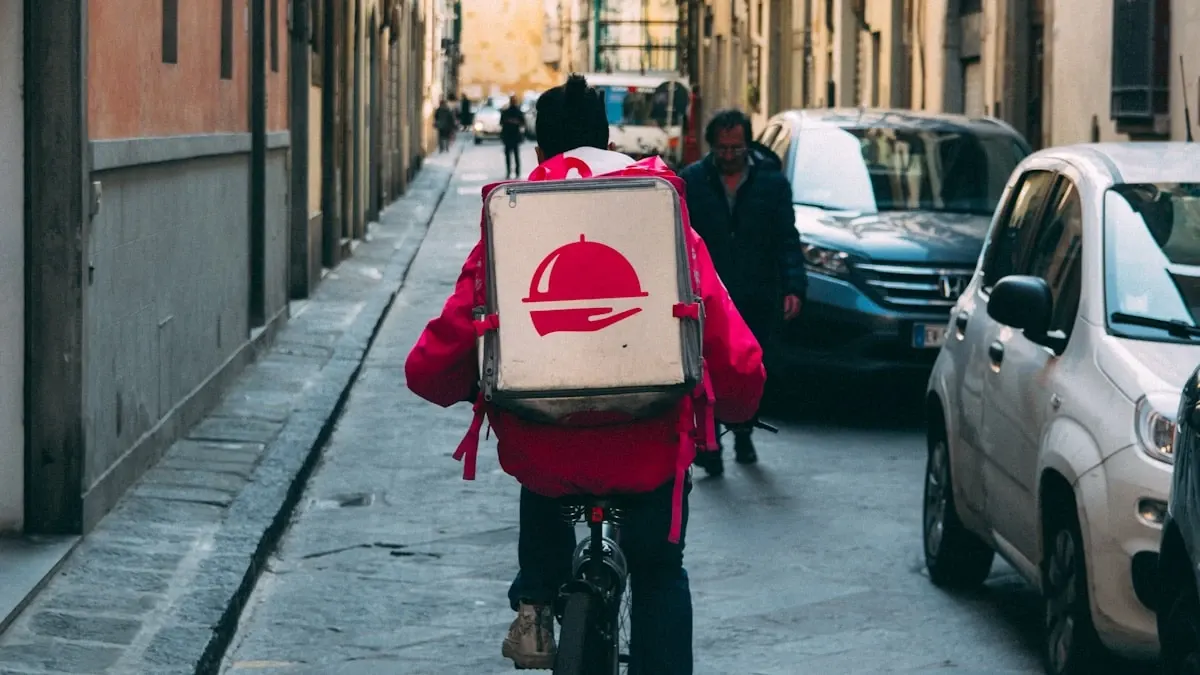
It is Friday evening at 7:45 PM. A family in the car decides they want Thai food delivered by the time they get home. Someone pulls out their phone, taps open WhatsApp, and types: "Hey, can I get the pad thai combo with extra peanuts?" Within seconds, an AI assistant responds with the full order summary, suggests adding spring rolls based on their last order, and confirms a 25-minute delivery window. The family never spoke to a human. The restaurant never missed the order. And the driver was already being dispatched before the customer hit "confirm."
That seamless experience is not a concept demo. It is how AI is already reshaping food delivery across every stage of the process, from the moment a craving strikes to the second food arrives at the door. But most of what AI does happens where customers cannot see it. This article follows a delivery order through its entire lifecycle to reveal every AI touchpoint along the way.
Part 1: What Customers See
The Customer's View: AI You Can Feel
When you order food through a messaging app, AI is already working before you finish typing. Here is what a real delivery ordering conversation looks like from the customer's side of the screen.
Ordering Delivery via WhatsApp
In that two-minute conversation, the AI verified the delivery address and calculated distance, recalled past order preferences and made a personalized suggestion, applied an active promotion automatically, and initiated driver assignment before the customer finished reading. Every one of those steps would have taken a human worker significantly longer.
- < 30 s
Seconds to complete an order via chat
- 35%
Higher average ticket with AI upsells
- 24/7
Ordering availability without extra staff
- 98%
Order accuracy rate with AI
The best AI in food delivery is the kind customers never notice. It just feels like everything worked perfectly.
Part 2: Behind the Scenes
Behind the Scenes: The AI Customers Never See
While the customer tracks their delivery, an entirely different layer of AI runs behind the kitchen doors. These systems handle the complex logistics that make fast, accurate delivery possible at scale.
AI Systems Running Behind Every Delivery
Demand Forecasting and Prep Optimization
AI analyzes historical order patterns, weather data, local events, and day-of-week trends to predict how many orders a restaurant will receive in the next hour. Kitchens use these predictions to pre-prep ingredients, staff appropriately, and reduce both waste and wait times.
Dynamic Delivery Routing and ETA Prediction
Every time a new order is placed, AI recalculates optimal delivery routes across all active drivers in real time. It factors in traffic patterns, current driver locations, restaurant prep times, and the number of stops a driver already has. The result is ETAs accurate within a few minutes.
Kitchen Load Balancing
When multiple delivery orders arrive simultaneously, AI sequences them based on prep complexity, ingredient overlap, and driver arrival times. A stir-fry that takes 8 minutes and a salad that takes 2 minutes for the same driver get timed so both finish together.
Inventory Management and Waste Reduction
AI tracks ingredient consumption in real time and cross-references it with predicted demand. When stock of a key ingredient drops below threshold, it can flag the item, adjust menu availability, or trigger a supplier reorder. Restaurants using AI inventory management typically see 20-30% less food waste.
Driver Assignment and Dispatch Optimization
Rather than assigning the nearest available driver, AI considers multiple factors: driver rating, vehicle type, current route efficiency, and restaurant prep time. The goal is to minimize total delivery time across all active orders, not just the next one.
What makes these systems powerful is that they operate simultaneously and feed into each other. The demand forecast informs kitchen prep. Kitchen prep time feeds into ETA prediction. The ETA determines driver dispatch. It is a continuous feedback loop that gets smarter with every order.
The AI Delivery Pipeline
What happens in the two minutes between 'confirm' and 'preparing'
Order Received
AI validates address, calculates delivery fee, applies promotions
Kitchen Routing
AI sequences the order based on prep time and current kitchen load
Driver Matched
AI assigns optimal driver based on location, route, and timing
ETA Calculated
Real-time traffic and prep data produce an accurate delivery window
Customer Notified
Tracking link sent with live updates throughout delivery
Part 3: The Delivery Ecosystem
Third-Party Apps vs. Direct Ordering: Where AI Differs
Not all delivery AI is built equal. The AI powering DoorDash, Uber Eats, and Grubhub optimizes for the platform's goals -- maximizing orders across all restaurants. Restaurant-owned AI channels optimize for that specific restaurant's goals -- higher margins, repeat customers, and brand loyalty.
AI Across the Delivery Ecosystem
Third-Party Apps
Platform-wide optimization
AI routes orders across thousands of restaurants to maximize platform revenue and driver utilization
Algorithmic restaurant ranking
Search placement depends on acceptance rate, speed, and commission tier, not just food quality
Dynamic surge pricing
Delivery fees fluctuate based on demand, weather, and driver availability across the whole network
Cross-restaurant recommendations
AI suggests competitors' dishes alongside yours, splitting customer loyalty
Direct AI Ordering
Restaurant-first optimization
AI focuses on maximizing that restaurant's revenue, ticket size, and repeat orders
Full customer data ownership
Order history, preferences, and contact info stay with the restaurant, not the platform
No marketplace commission
No 15-30% cut to a platform means higher margins on every delivery order
Personalized brand experience
AI speaks in the restaurant's voice and promotes only their menu and deals
Hybrid Approach
Use platforms for discovery
Third-party apps bring new customers who have never heard of the restaurant
Convert to direct channels
AI-powered WhatsApp/Instagram ordering captures repeat customers at no marketplace commission. A 5% technology fee applies only to eligible AI-order revenue; subscription and other applicable costs are separate.
Data-driven channel strategy
AI analytics reveal which customers come from which channel and their lifetime value
Delivery Operations: Before and After AI
How AI changes the delivery experience at every level
Without AI
Phone tag for orders
Customers call during rush hour, get put on hold, hang up
Manual address entry
Staff writes down addresses, makes errors, deliveries go wrong
Guessed delivery times
Vague 30-45 minute windows that frustrate customers
30% platform commissions
Third-party apps take a huge cut of every order
With AI Ordering
Instant chat ordering
Customers order via WhatsApp anytime, AI handles everything
Verified addresses
AI validates delivery addresses and calculates fees automatically
Precise ETAs
AI-calculated delivery windows accurate to within minutes
No marketplace commission
Direct orders mean revenue remains with the restaurant before applicable fees and costs. A 5% technology fee applies only to eligible AI-order revenue; subscription and other applicable costs are separate.
See It In Action
AI-Powered Delivery Ordering for Your Restaurant
Ordering.co handles delivery orders on WhatsApp and Instagram with no marketplace commission. Your customers order in natural conversation. Your kitchen gets structured orders. A 5% technology fee applies only to eligible AI-order revenue; subscription and other applicable costs are separate.
Part 4: What Comes Next
The Near Future of AI in Delivery
The AI capabilities powering delivery today are only the beginning. Several emerging technologies are poised to change the economics and speed of food delivery even further within the next few years.
Predictive Pre-Preparation
AI begins cooking your regular Friday order before you even place it, based on behavior patterns and real-time signals like your location heading home.
Autonomous Last-Mile Delivery
Sidewalk robots and drones handle short-distance deliveries, reducing costs and delivery times to under 15 minutes for nearby orders.
Dynamic Menu Pricing
AI adjusts delivery menu prices in real time based on ingredient costs, demand patterns, and competitive positioning, maximizing margins automatically.
Cross-Restaurant AI Bundles
AI coordinates orders from multiple nearby restaurants into a single delivery, letting customers build multi-cuisine meals with one delivery fee.
While some innovations are still emerging, the foundational AI capabilities -- conversational ordering, demand forecasting, smart routing, and personalized upselling -- are available right now. Restaurants that adopt them today build the data advantage that makes every future capability more effective.
Take Action
Start Using AI for Delivery in 4 Steps
A practical path from today's operations to AI-powered delivery
Audit your delivery channels
Count how many orders come through phone, apps, and messaging. Identify where you lose the most orders and pay the highest commissions.
Set up direct AI ordering
Launch WhatsApp or Instagram ordering with an AI assistant that handles your full menu, delivery zones, and payment processing.
Redirect repeat customers
Use packaging inserts, social media, and follow-up messages to move loyal customers from third-party apps to your direct channel.
Monitor and optimize weekly
Review AI analytics for order patterns, popular items, delivery times, and commission savings. Let the data guide your next moves.
Frequently Asked Questions
Common questions about AI in food delivery
How does AI handle delivery orders on WhatsApp?
AI reads the customer's natural language message, identifies menu items and modifications, validates the delivery address, calculates fees and ETAs, applies available promotions, and confirms the order -- all within a conversational chat flow that takes under two minutes.
Does AI replace delivery drivers?
No. AI optimizes how drivers are assigned and routed, making their work more efficient. Drivers spend less time waiting and more time delivering. Autonomous delivery robots are emerging for short distances, but human drivers remain essential for the vast majority of deliveries.
How much can restaurants save by switching from third-party apps to direct AI ordering?
In an example of 100 monthly orders at $30, avoiding 15-30% marketplace commission represents $450-$900 gross. If every order is AI-eligible, the 5% technology fee is $150, leaving $300-$750 before subscription, delivery, payment processing, and other charges. Savings are not guaranteed.
Can AI really predict what customers will order?
Yes, with increasing accuracy. AI analyzes order history, time of day, day of week, weather, and seasonal patterns to suggest items customers are most likely to want. Personalized suggestions can increase average ticket size by 20-35%.
How accurate are AI-generated delivery ETAs?
Modern AI delivery ETAs are accurate within 3-5 minutes for most orders. The system factors in real-time traffic, restaurant prep time, driver location, and historical delivery data for that specific route.
Is AI ordering available in languages other than English?
Yes. AI ordering platforms like Ordering.co support multilingual conversations. Customers can order in their preferred language, and the system processes the order accurately regardless of language used.
How does AI reduce food waste in delivery operations?
AI predicts demand patterns and adjusts prep quantities accordingly. It can also modify menu availability in real time when ingredients run low, preventing orders for items that would require emergency restocking or substitution.
How long does it take to set up AI-powered delivery ordering?
Most restaurants can launch AI ordering on WhatsApp or Instagram within a day. The setup involves uploading the menu, configuring delivery zones and fees, and connecting a payment method. No technical expertise is required.
Ready to Launch AI-Powered Delivery?
See how Ordering.co can handle your delivery orders on WhatsApp and Instagram with no marketplace commission. A 5% technology fee applies only to eligible AI-order revenue; subscription and other applicable costs are separate.