

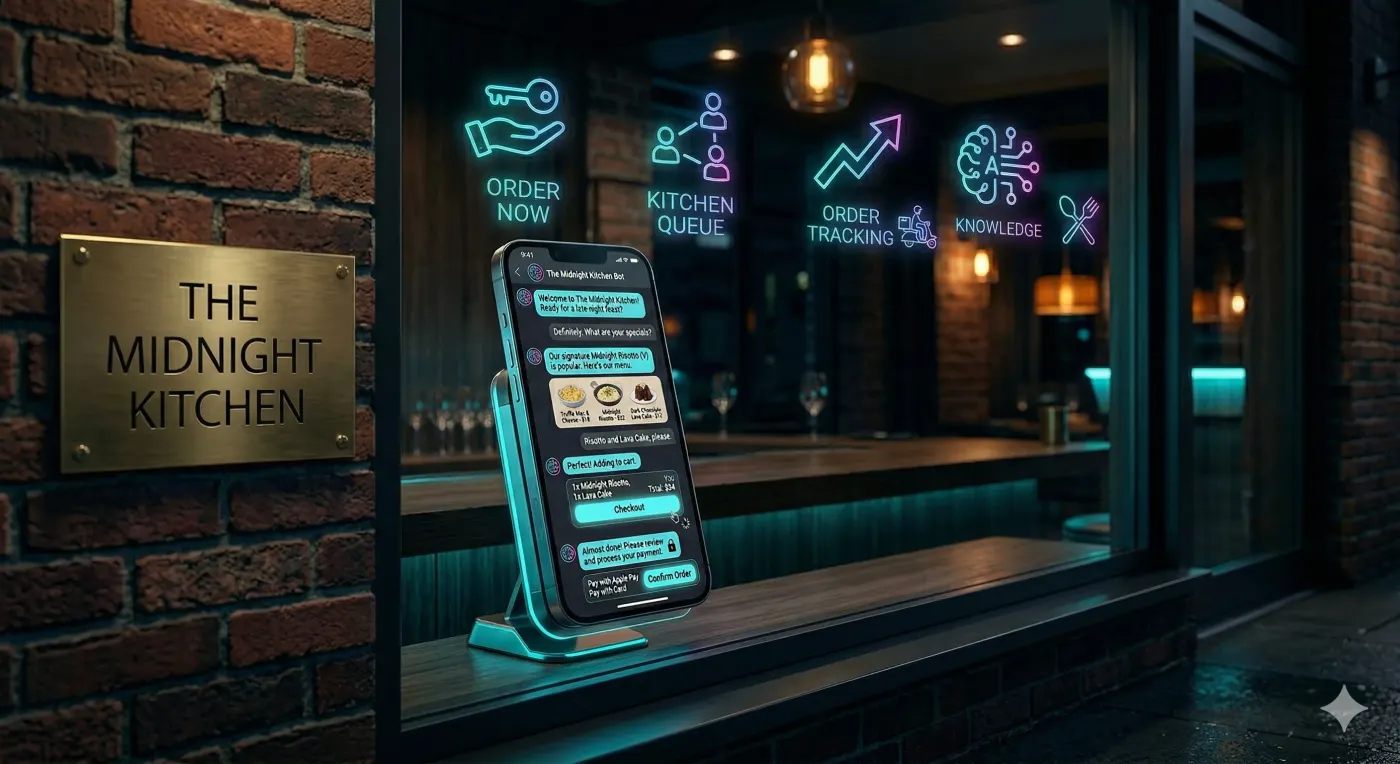
What Is Conversational Commerce?
Conversational commerce is the intersection of messaging technology and buying. It refers to any transaction that happens through a conversation, whether via WhatsApp, SMS, Instagram DM, or a website chatbot. Instead of navigating a website, downloading an app, or waiting on hold, customers simply message a business to browse, order, and pay.
For restaurants, this is not a futuristic concept. It is already how millions of consumers prefer to order food. The shift from phone calls and third-party apps to direct messaging is accelerating, and restaurants that embrace conversational commerce are capturing revenue that others leave on the table.
- 72%
of consumers prefer messaging over calling a business
- 130B+
messages sent daily on WhatsApp alone
- 53%
of customers more likely to buy from a business they can message
The Evolution of Conversational Commerce in Restaurants
2015-2017
The Chat Era Begins
Facebook Messenger bots launch. Early restaurant experiments with simple FAQ bots that answer hours and location questions.
2018-2019
WhatsApp Business API Opens
Restaurants in Latin America, Europe, and Asia begin taking orders via WhatsApp. Basic menu sharing and manual order processing become common.
2020-2021
Pandemic Acceleration
COVID-19 forces digital adoption. Restaurants with messaging channels saw 3x faster recovery in order volume compared to phone-only operations.
2022-2023
AI Gets Conversational
Large language models make chatbots truly conversational. They understand context, handle modifications, and upsell naturally like a skilled server.
2024-Present
Full Commerce in Chat
End-to-end ordering, payment, loyalty, and re-engagement happen entirely inside messaging apps. This is conversational commerce at scale.
Why Conversational Commerce Is a Game-Changer for Restaurants
Restaurants operate differently from other businesses. Thin margins, high volume, time-sensitive demand, and heavy reliance on phone orders create a unique set of challenges. Conversational commerce addresses all of these pain points simultaneously, turning messaging channels into revenue engines that work around the clock.
The Hidden Revenue Leak in Traditional Restaurant Ordering
Missed Calls During Rush Hours
Up to 35% of incoming calls go unanswered during peak periods. Each missed call is a lost order worth $25-45 on average.
Limited Ordering Hours
Most restaurants only take phone orders during business hours, missing late-night cravings and early morning catering requests entirely.
Long Hold Times Drive Customers Away
67% of customers hang up when put on hold. They order from a competitor instead, and rarely come back to try again.
Order Errors from Phone Miscommunication
Phone orders have a 10-15% error rate due to background noise, accents, and rushed conversations, leading to costly remakes and unhappy customers.
The Cost of These Gaps
- $1,000+/week
lost in missed calls alone
- 15%
order error rate by phone
- 67%
of customers won't call back
How a Typical Restaurant Loses Revenue Without Conversational Commerce
100 Potential Customers Try to Reach You
Customers see your ad, Google listing, or social media post and want to order.
35 Get a Busy Signal or No Answer
-35%
During peak hours, staff cannot answer every call. These customers try once and move on.
12 Hang Up While on Hold
-12%
Of those who get through, some are put on hold and give up within 30 seconds.
8 Orders Have Errors, 3 Request Refunds
-3%
Miscommunication leads to wrong items, missed modifications, and costly remakes.
50 Orders Actually Completed Correctly
50%
Only half of interested customers convert to a successful, error-free order.
Revenue captured Only 50% of potential orders
How Restaurant Chatbots Actually Work
Modern AI chatbots are not the clunky decision-tree bots of 2016. They understand natural language, remember customer preferences, and guide conversations like a skilled server would. When a customer messages your restaurant, the chatbot handles the entire interaction: greeting, menu browsing, order customization, upselling, payment, and confirmation.
A Real Conversational Commerce Interaction
What a Conversational Commerce Chatbot Handles for Your Restaurant
End-to-End Ordering
Customers browse your menu, customize items, and complete checkout entirely inside the chat. No app downloads, no website navigation required.
Smart Upselling and Cross-Selling
AI suggests add-ons, combo upgrades, and popular pairings based on what the customer ordered. Average order value increases 15-25%.
24/7 Availability
Your chatbot never takes a break. It handles orders at 2 AM, during Sunday brunch rush, and on holidays when you are short-staffed.
Multilingual Support
Serve customers in their preferred language automatically. No need to hire bilingual staff for every shift.
Customer Data and Insights
Every conversation generates data: popular items, peak ordering times, common requests. Use it to optimize your menu and operations.
Measured Outcomes
- 24/7
order availability
- 20%
average increase in order value
- 0%
missed orders
Restaurant Operations: Before vs. After Conversational Commerce
Without Chatbot
Phone-Only Orders
Staff manually takes orders, handles questions, and processes payments while managing the floor.
Business Hours Only
Orders stop when the phone stops ringing. Late-night demand goes to competitors.
Missed Calls = Lost Sales
No way to capture demand that comes in during peak periods or after hours.
Manual Upselling (Inconsistent)
Depends on which staff member answers. Training is expensive and turnover is high.
With AI Chatbot
Multi-Channel Ordering
Customers order via WhatsApp, Instagram, website chat, or SMS. All integrated into one system.
24/7 Revenue Capture
Orders come in around the clock. The chatbot handles everything from menu browsing to payment.
Zero Missed Orders
Every inquiry gets an instant response. No busy signals, no hold music, no lost customers.
Automated Upselling (Every Time)
AI suggests relevant add-ons on every single order, consistently and naturally.
Common Myths About Restaurant Chatbots
Myth: Chatbots feel robotic and customers hate them
Reality: Modern AI chatbots are conversational and friendly. 74% of customers actually prefer messaging over phone calls for ordering.
Myth: Setting up a chatbot requires a technical team
Reality: Today's solutions are plug-and-play. Upload your menu, connect your channels, and go live in days, not months.
Myth: Chatbots only work for big restaurant chains
Reality: Independent restaurants often see the biggest ROI because they have the most to gain from automation. A single missed call matters more when you have one location.
Myth: Customers want to talk to a real person when ordering food
Reality: For routine ordering, most customers prefer speed and convenience. Chatbots handle standard orders while staff focus on in-house guests and complex requests.
Myth: AI will replace my restaurant staff
Reality: AI handles repetitive tasks (taking orders, answering FAQs) so your team can focus on hospitality, food quality, and the guest experience that keeps people coming back.
The Real ROI: What the Numbers Say
The business case for conversational commerce in restaurants is built on three pillars: recovered revenue from missed orders, increased average order value from consistent upselling, and reduced labor costs from automating repetitive phone work. Here is what that looks like for a typical single-location restaurant.
| Recovered missed orders (10/day x $30 avg) | $9,000/mo |
|---|---|
| Upsell revenue (+$2.50 per order, 80 orders/day) | $6,000/mo |
| Labor savings (fewer phone-handling hours) | $1,500/mo |
| Chatbot cost | -$300/mo |
| Net Monthly Revenue Impact | $16,200 |
Based on a single-location restaurant averaging 80 daily orders. Results vary by volume and average ticket size. | |
How to Get Started with Conversational Commerce for Your Restaurant
The shift to conversational commerce does not require a massive technology overhaul. You can start with one messaging channel and scale as you see results. Here is a practical roadmap.
Getting Started
5 Steps to Launch Conversational Commerce at Your Restaurant
From zero to taking orders via chat in under a week
Digitize Your Menu
Ensure your menu is up to date with prices, descriptions, and item modifications. This becomes the foundation for your chatbot's knowledge.
Choose Your Primary Channel
Start where your customers already are. WhatsApp is dominant in Latin America and Europe. SMS works well in the US. Instagram DM is great for visual-first restaurants.
Set Up Your AI Chatbot
Connect your menu, set your operating hours, delivery zones, and payment methods. Modern platforms handle this in a guided setup flow.
Test with Real Scenarios
Place test orders, try unusual requests, test modifications and cancellations. Make sure the experience feels natural before going live.
Promote Your New Channel
Add your WhatsApp number to Google Business Profile, social media bios, receipts, and in-store signage. Tell customers they can now order by messaging you.
Feature
- Response time
- Order capability
- Upselling
- After-hours availability
- Customer preference
AI Chatbot (WhatsApp/SMS)
- Instant (< 5 sec)
- Full menu with modifications
- Automated, every order
- 24/7
- 72% prefer messaging
Phone Orders
- Varies (hold times)
- Full, but error-prone
- Depends on staff
- Business hours only
- Declining preference
Third-Party Apps
- App-dependent
- Limited by platform
- Platform-controlled
- 24/7 (with 15-30% fees)
- High commissions reduce margin
The restaurants that will thrive in the next five years are the ones that meet customers where they already spend their time: inside messaging apps.
Ready to Stop Missing Orders?
See How Ordering.co Can Power Your Restaurant's Conversational Commerce
Our AI chatbot integrates with WhatsApp, Instagram, and your website to capture every order, upsell naturally, and work 24/7. No technical setup required.
Frequently Asked Questions About Conversational Commerce for Restaurants
Everything restaurant owners need to know about chatbot ordering
What is conversational commerce for restaurants?
Conversational commerce is the practice of using messaging channels like WhatsApp, SMS, or Instagram DM combined with AI chatbots to let customers browse menus, place orders, make payments, and get support entirely through a chat conversation. For restaurants, it replaces or supplements phone ordering with a faster, more accurate, always-available alternative.
How much does a restaurant chatbot cost?
Modern restaurant chatbot solutions typically range from $200 to $500 per month for a single location, depending on features and order volume. Compared to the revenue recovered from missed calls alone (often $1,000+ per week), the ROI is typically positive within the first month.
Do I need technical skills to set up a chatbot?
No. Today's conversational commerce platforms are designed for restaurant owners, not developers. You upload your menu, connect your messaging channels, and configure your preferences through a guided setup. Most restaurants go live within a few days.
Will customers actually use a chatbot to order food?
Yes. Research shows 72% of consumers prefer messaging over calling a business. Younger demographics (18-44) are especially likely to order via chat. The key is making the experience available on channels customers already use daily, like WhatsApp or Instagram.
Can a chatbot handle complex orders with modifications?
Modern AI chatbots understand natural language requests like 'chicken sandwich, no mayo, extra pickles, and can I add a side of ranch?' They handle modifications, combos, dietary restrictions, and special requests just like a well-trained staff member.
What happens if the chatbot cannot answer a question?
Good conversational commerce platforms include seamless handoff to a human agent. If the AI encounters a request it cannot handle, it transfers the conversation to a staff member with full context, so the customer never has to repeat themselves.
How does conversational commerce compare to third-party delivery apps?
Third-party apps charge 15-30% commission per order and own the customer relationship. With conversational commerce, you keep the margin before usage charges and other costs, own your customer data, and build direct relationships. You can still offer delivery through your own drivers or integrate with delivery partners at lower cost. A 5% technology fee applies only to eligible AI-order revenue; subscription and other applicable costs are separate.
Is conversational commerce only for delivery orders?
It works for all order types: delivery, pickup, dine-in pre-orders, catering requests, and even table reservations. Some restaurants also use it for loyalty programs, sending personalized promotions to past customers via the same messaging channel.
Conversational Commerce for Your Restaurant
Start Capturing Every Order Today
Join the restaurants already using Ordering.co to take orders via WhatsApp, Instagram, and web chat. No missed calls, no marketplace commission, no technical headaches. A 5% technology fee applies only to eligible AI-order revenue; subscription and other applicable costs are separate.