

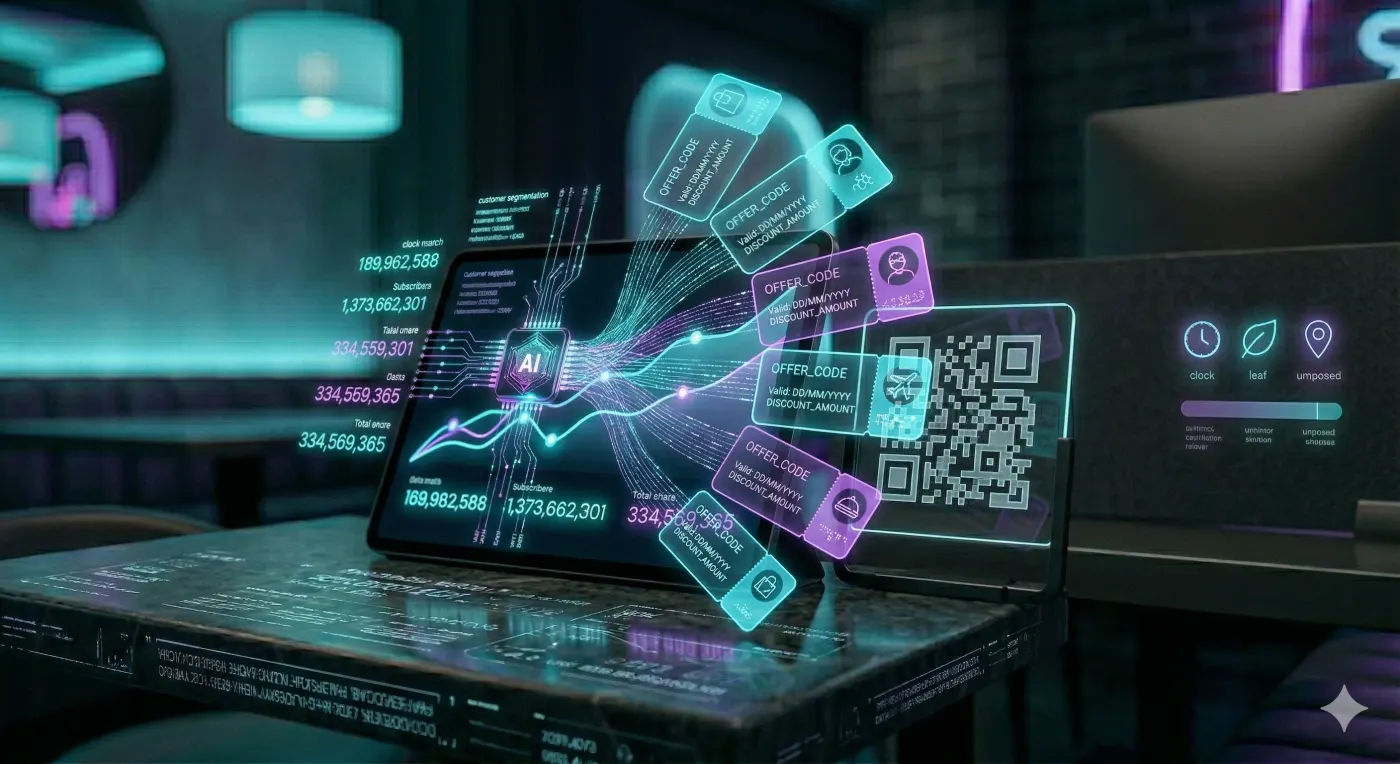
A 10% off everything coupon treats your best customer the same as someone who visited once six months ago. AI does not. It sends the steak lover a ribeye special, the vegetarian a new plant-based entree, and the lapsed customer a we miss you offer calibrated to bring them back. Same budget. Radically different results.
The Problem with One-Size-Fits-All Discounts
Most restaurant promotions work like a megaphone: one message, blasted to everyone. 20% off this weekend. Free appetizer with any entree. The same coupon goes to your most loyal regular, a first-time visitor, and someone who has not eaten with you in three months. The result is massive coupon waste, margin erosion, and offers that feel generic to every recipient.
The loyal regular would have come anyway. You just gave them a discount they did not need. The lapsed customer needed a bigger incentive but got the same 20% everyone else did. And the first-time visitor got a deal that had nothing to do with what they actually like to eat. Personalized offers solve all three problems simultaneously by matching the right offer to the right customer at the right time.
- 175x
ROI of personalized vs generic coupons
- 25%
Customer lifetime value lift from personalization
- 62%
Consumers expect personalized offers
- 37%
At-risk customers recovered with AI offers
How AI Creates a Unique Offer for Every Customer
True personalization is not segmenting your customers into three buckets and sending each bucket a slightly different email. It is creating an individually calculated offer for every single customer based on their complete behavioral profile. AI makes this possible at scale because no human team could manually analyze thousands of customer profiles and generate unique offers for each one. But an AI system does it in milliseconds.
The Personalization Engine
How AI builds a unique offer for each customer
Ingest Behavioral Data
Order history, visit frequency, average spend, dietary preferences, time-of-day patterns, favorite items, and response to previous offers.
Build Customer Profile
AI creates a 360-degree profile: high-value weekday luncher who orders vegetarian, visits biweekly, responds to free dessert offers.
Calculate Optimal Offer
Algorithm determines the minimum incentive needed to drive the desired action: a visit, an upsell, a return, or a referral.
Generate Unique Coupon
A one-time-use code tailored to this specific customer. Impossible to share, perfectly trackable, fraud-proof.
Deliver at Optimal Time
Sent via the customer's preferred channel (chat, SMS, email) at the moment they are most likely to act.
Generic Discounts vs. Personalized Offers: The Real Cost
Generic discounts feel cheaper to run because there is no technology cost. But they are far more expensive in the metrics that actually matter: margin erosion, wasted incentives, and missed opportunities.
Generic Discounts
- Same offer to every customer
- Discounts customers who would buy anyway
- Low redemption (most ignore it)
- No behavioral learning
- Margin erosion across entire base
- Cannot track individual impact
- Trains customers to wait for deals
AI Personalized Offers
- Unique offer per customer profile
- Targets only customers who need incentive
- High redemption (relevant = valuable)
- Every offer generates behavioral data
- Margin preserved through precision
- Individual attribution and ROI tracking
- Trains customers to engage with your brand
7 Behavioral Triggers That Power Personalized Offers
The magic of AI-driven personalization is not just what offer to send, but when to send it based on real behavioral signals. Each trigger represents a moment of maximum receptivity.
Lapsed Visit Detection
Customer has not ordered in 30+ days. AI sends a personalized win-back offer with their favorite dish at a calibrated discount. 37% recovery rate.
Birthday and Anniversary
Special date approaching. AI sends a celebration invitation with complimentary dessert or exclusive tasting. Highest emotional impact.
Weather-Based Triggers
Rainy evening detected. AI sends cozy dinner deals to delivery fans. Hot afternoon triggers cold drink promotions. Contextual relevance converts.
Time-of-Day Matching
Morning customer gets breakfast offers. Evening diner gets dinner promotions. Weekend bruncher gets Saturday specials. Right offer, right daypart.
Category Preference Shifts
Customer who usually orders steak tried a seafood dish last visit. AI offers a seafood tasting menu to explore the new interest.
Spend-Level Optimization
High spenders get VIP experiences and exclusive access. Budget-conscious diners get value deals. Each gets the incentive type that resonates.
Engagement Response Patterns
Customer who redeems SMS offers gets more SMS. Email responder gets richer email content. Non-responder gets a different channel or stronger incentive.
The Minimum Viable Discount: Stop Leaving Money on the Table
One of the most overlooked benefits of AI personalization is discount depth optimization. A generic coupon gives everyone 20% off because you do not know who needs 5% and who needs 30%. AI figures out the minimum incentive required to drive action for each individual customer.
AI-Optimized Discount Depth by Customer Type
| Customer Type | Generic Approach | AI Personalized Approach | Margin Saved |
|---|---|---|---|
| Loyal regular (weekly) | 20% off (unnecessary) | Loyalty points + exclusive access | Full margin preserved |
| Occasional visitor (monthly) | 20% off (too low to change behavior) | 15% off their favorite dish + free side | 5% more margin vs generic |
| Lapsed customer (60+ days) | 20% off (not enough to win back) | 30% off + personalized message | Higher spend from recovered customer |
| New customer (1st visit) | 20% off (trains them to expect deals) | Welcome back: free dessert on 2nd visit | Builds habit, not deal-seeking |
| High spender (top 10%) | 20% off (margin giveaway) | Chef's table invitation, no discount | Premium experience, zero margin loss |
| Budget-conscious diner | 20% off (appreciated but unfocused) | Value combo at 12% off on slow nights | 8% more margin, fills empty seats |
What Starbucks Taught the Industry About Personalization
Starbucks is the gold standard of personalized restaurant marketing. Their AI-powered mobile app analyzes purchase history, time of day, and even local weather to suggest the perfect drink for each customer at each moment. The result? Over $1 billion in incremental revenue driven by personalization alone. But you do not need Starbucks' budget to achieve Starbucks-level personalization. AI chat platforms now deliver this capability to independent restaurants.
53% of restaurants already use AI for marketing and personalization. The remaining 47% are not saving money by avoiding it. They are spending more on generic promotions that convert less.
Building Your Personalization Stack: From Data to Delivery
Personalization at scale requires four layers working together. The good news: modern AI platforms bundle all four into a single solution, so you do not need to assemble a Frankenstein stack of disconnected tools.
Tech Stack
The 4-Layer Personalization Stack
From customer data to individual offers
Data Collection Layer
Chat conversations, ordering history, reservation patterns, and loyalty interactions feed into a unified customer profile. Every touchpoint adds signal.
AI Intelligence Layer
Machine learning analyzes profiles to predict preferences, optimal timing, discount sensitivity, and churn risk for each individual customer.
Offer Generation Layer
The system creates unique coupon codes, tailored menu recommendations, and personalized messages for each customer automatically.
Delivery and Measurement Layer
Offers are sent via the customer's preferred channel at the optimal time. Every redemption feeds back into the AI, improving future predictions.
Measuring Personalization Impact
The right metrics prove personalization is working. Track these across three dimensions to understand the full impact on your restaurant's bottom line.
Personalization Performance Dashboard
Engagement
Offer Open Rate
Percentage of personalized offers that are read. Target: 80%+ for chat, 40%+ for email.
Redemption Rate
Percentage of opened offers that are redeemed. Personalized benchmark: 15-25% vs 2-5% generic.
Response Time
How quickly customers act on personalized offers. Faster response indicates higher relevance.
Revenue
Revenue per Offer Sent
Total revenue generated divided by offers sent. Should increase as personalization improves.
Average Order Value Lift
Compare AOV of personalized offer orders vs organic orders. Target: 10-15% lift.
Incremental Revenue
Revenue from customers who would not have ordered without the personalized offer.
Efficiency
Discount Depth vs Generic
Average discount given on personalized offers vs what a generic promotion would cost. Target: 30-50% less.
Customer Recovery Rate
Percentage of at-risk customers brought back by AI-triggered offers. Benchmark: 37%.
Margin Preservation
Compare gross margin on personalized promotions vs generic discounts. Personalization should protect 5-10% more margin.
Ready for Offers That Actually Convert?
Send Every Customer the Perfect Offer, Automatically
Ordering.co AI analyzes ordering behavior, predicts preferences, and generates unique personalized offers for every customer. Better conversions, better margins, zero manual work.
Frequently Asked Questions
AI-powered personalized offers for restaurants
What makes personalized offers different from regular restaurant promotions?
Personalized offers use AI to create unique incentives for each individual customer based on their order history, preferences, visit patterns, and behavioral triggers. Instead of sending the same 20% off coupon to everyone, each customer receives a tailored offer calibrated to their specific profile.
How much better do personalized coupons perform than generic discounts?
Personalized coupons deliver up to 175x ROI compared to generic discounts. They achieve 15-25% redemption rates versus 2-5% for generic offers. Restaurants also see 25% customer lifetime value lifts and 10-15% increases in average order value from personalized campaigns.
What data does AI use to personalize restaurant offers?
AI analyzes order history, visit frequency, average spend, dietary preferences, time-of-day patterns, favorite menu items, response to previous offers, weather conditions, and special dates like birthdays and anniversaries. Every interaction adds data that makes future offers more precise.
Can small independent restaurants use AI personalization?
Modern AI platforms make personalization accessible to restaurants of any size. You do not need Starbucks' budget or a data science team. Chat-based AI systems automatically collect customer data during ordering conversations and generate personalized offers without manual effort.
How does AI determine the right discount amount for each customer?
AI calculates the minimum viable discount: the smallest incentive needed to drive the desired action for each customer. Loyal regulars might get exclusive access instead of a discount. Lapsed customers might get a deeper discount on their favorite dish. The system optimizes for both conversion and margin preservation.
What are the most effective behavioral triggers for personalized offers?
The highest-performing triggers are lapsed visit detection (37% recovery rate), birthday and anniversary dates (highest emotional impact), weather-based triggers (contextual relevance), time-of-day matching, category preference shifts, spend-level optimization, and engagement response patterns.
Does personalization reduce coupon waste and margin erosion?
Significantly. Generic discounts give unnecessary discounts to customers who would buy anyway, eroding margins across your entire base. AI personalization targets only customers who need incentives, uses the minimum discount depth required, and preserves full margin on customers who do not need offers.
How do restaurants measure the success of personalized offers?
Track three dimensions: engagement (offer open rate, redemption rate, response time), revenue (revenue per offer sent, average order value lift, incremental revenue), and efficiency (discount depth vs generic, customer recovery rate, margin preservation). Personalized campaigns should show improvement across all three.
Stop Discounting Blindly. Start Personalizing Intelligently.
AI-powered offers that convert better and cost less than generic promotions.